
DailyQuad Playbooks
A plan from someone who knows you.
A Playbook is a few daily goals somebody sets for you, for a few weeks. A coach, a trainer or a friend picks the things to work on and shares a code. You check in for yourself, and they can see how the days are going.
Free. iPhone and iPad, iOS 15 or later. No sign up or email needed to join.
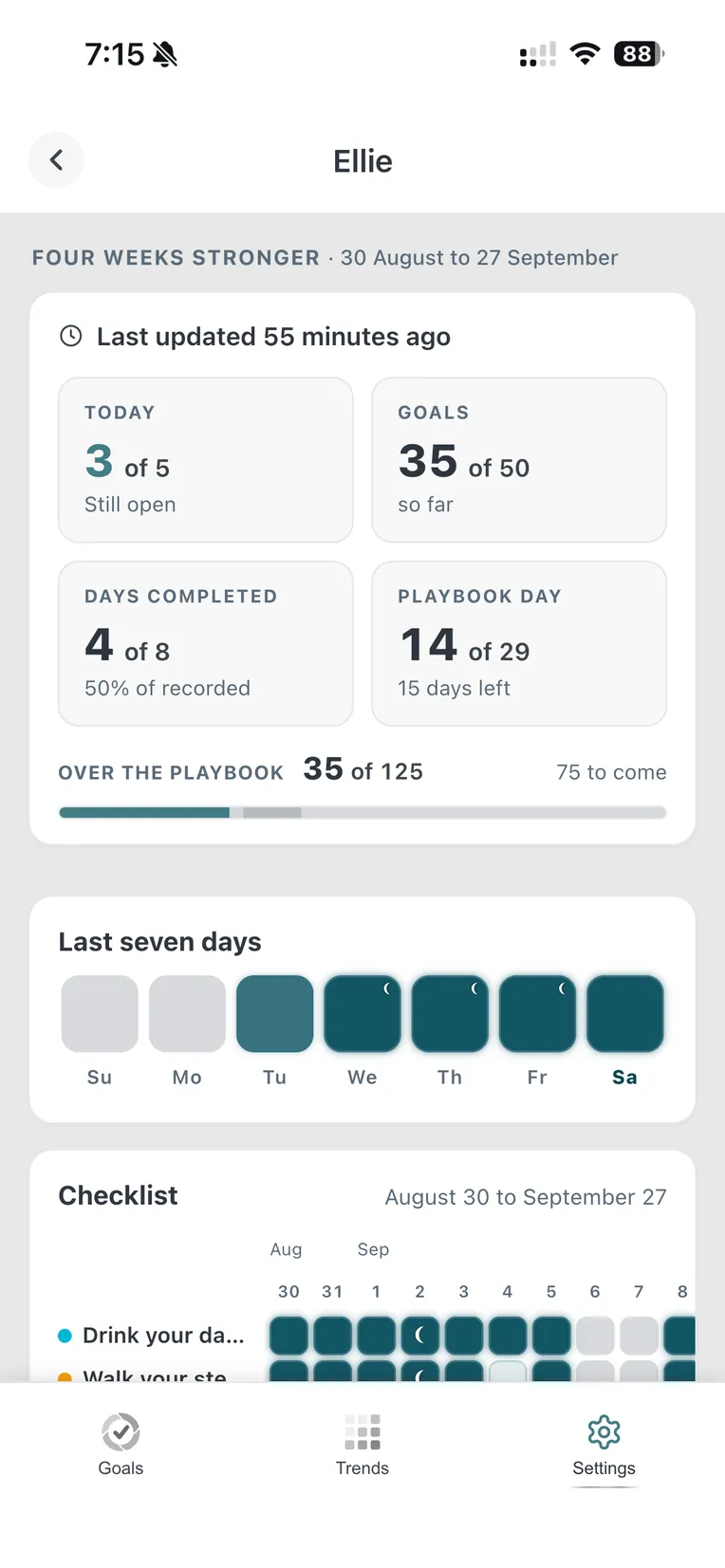

Three steps, then it gets out of the way.
Someone sets the goals
A few things to do daily, and the weeks they run for. Four goals, or more if the plan needs them.
They send each person a code
One code each, by message, link or QR. A code works once, so it cannot be passed on after somebody has used it.
Everyone checks in
The goals arrive on your own Goals page beside whatever you already track. You tick them off for yourself.
One of you writes it. The other lives it.
A Playbook has two ends and they need different things. One person needs to set it and watch it. Everybody else needs it to stay out of the way.
If you set the goals
Somebody who coaches, trains or teaches, or a friend who has been asked for help.
- As many Playbooks as you want, each with its own goals and dates
- One person, or a group of up to fifty in the same Playbook
- See each person's days, one at a time
- Use the app for your own goals too, on the same phone
If you are in one
Somebody sent you a code. That is the whole setup.
- Join without signing up or giving an email address
- The Playbook's goals sit beside your own, which stay private
- Check in for yourself, the same as any other day
- Leave whenever you want, and the sharing stops


How it is going, without asking.
The person who set the goals sees a grid of days: which goals were met, which were not, the days you took off, and when you last checked in. That is all that travels. No messages to send, no checking in on anybody.
- A day at a time. Every day of the Playbook, per goal, marked done or not.
- Days off count as days off. A rest day reads as a moon, not a miss.
- Nothing else crosses over. Goals outside the Playbook, metrics, medication and notes stay where they are.
- It ends on the date it said. When the weeks are up the Playbook closes itself.


Your data is yours. Even here.
Being in a Playbook shares one thing: whether you met that Playbook's goals, on each day it runs. It is the narrowest thing that still makes the feature work.
- Only the Playbook's goals. The goals you keep for yourself are never part of it.
- Only while you are in it. Leaving ends their access and deletes the shared copy from our servers. A summary somebody already saved to their own device stays theirs.
- Codes are used once. An invitation that has been accepted cannot be handed to somebody else.
- No sign up to join. You can take part without giving an email address at all.
- No ads and no subscription. Playbooks are part of the app, not a tier of it.
It started on a piece of paper.
A coach writes out four things for the next month. A trainer gives somebody four things to hold onto between sessions. A friend says they will do it with you. That plan ends up on paper or in a notebook, and then it ends up nowhere. A Playbook is the same plan, somewhere you both can see it.
- A trainer and the people they train. A different Playbook for each person, each on its own dates.
- A coach and a squad. One Playbook, everybody in it, each checking in for themselves.
- Two friends. The same four things for four weeks, so neither of you is doing it alone.
- A parent and a teenager. Something agreed together, with no nagging in between.
Three questions, answered straight.
Do I need to sign up to join one?
No. Somebody sends you a code, you enter it, and you are in, with no email address and no sign up. An account is optional and does two things: it keeps your record on a second device, and it means the record survives a lost or replaced phone. You can add one later, or never.
Can the person who set the goals see the rest of my app?
No. They see whether you met that Playbook's goals on each day it runs, the days you marked off, and when you last checked in. Nothing else. Your own goals, your metrics, any medication tracking and anything you write stay yours. If you leave, their access ends and the shared copy is deleted from our servers, though a summary they had already saved to their own device stays theirs.
Can the other people in a group see how I am doing?
No. A Playbook is not a leaderboard and there is no list of everybody's days. Each person's record can be read by that person and by whoever set the goals, and by nobody else. If ten people are in one Playbook, none of the ten can see the other nine.
How many people can be in one?
Up to fifty, and each one needs their own invitation code, since a code can only be used once. You can also run as many separate Playbooks as you like, which is what somebody looking after several people one at a time tends to want.
Write one out for somebody.
Or send this to whoever keeps telling you what you should be doing, and let them set it.
Free. No ads, no subscription, no sign up or email needed to join.